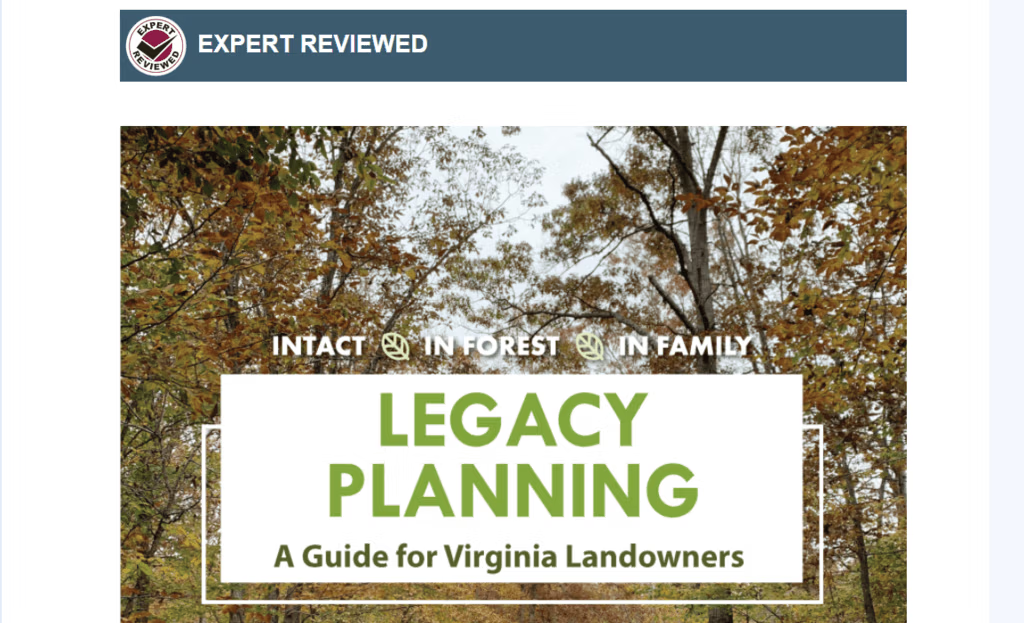

Preserving Your Agricultural Legacy – The 4 Pillars of Farm Succession Planning in Virginia
Think of your farm as a living system, where each element—from the soil to the crops to the people who tend them—contributes to something greater than the sum of its parts. Each morning, when sunlight brushes across your fields, it illuminates not just land and equipment, but also decades (or centuries) of dedicated stewardship. Memories of your grandfather safeguarding the oak grove in drought years, your parents teaching you to analyze soil composition, and your own innovations in grain storage and equipment management all serve as reminders of the legacy you carry forward.

Just as you plan each growing season with meticulous care—factoring in weather patterns, planting schedules, and resource allocation—planning for your farm’s future requires thoughtful consideration of many interconnected elements. At Prior Law, we know that preserving your agricultural heritage is more than drafting legal documents. It requires an understanding of day-to-day farm operations, the family members who devote themselves to those operations, and the unique challenges faced by Virginia’s farming community.
Laying the Groundwork: Why Farms Require Special Attention
Before examining these four pillars, it’s helpful to see why farms demand unique approaches in succession planning. Unlike many businesses, farms blend personal lives, specialized know-how, and immeasurable intrinsic value in ways that make any transition more complex.
A farm isn’t just a workplace; it’s often a generational home. The family’s emotional connection to the land can complicate financial decisions. Additionally, farming requires specialized knowledge that can’t be learned overnight. You develop your intuition for planting, harvesting, and adjusting to unpredictable weather through years of practical experience—wisdom that must be carefully transferred if the farm is to continue thriving under new leadership. Finally, while a developer might see only the acreage’s market value, you see the property’s real worth in its ongoing capacity to nourish families, provide livelihoods, and sustain the broader community.
Pillar One: Family Relationships and Communication
In the same way that healthy soil is essential for robust crops, open, honest communication among family members is essential for a smooth transition. Without well-prepared “ground” in the form of mutual understanding, even the best legal or financial tools can fail to take root.
Consider a farm family with three adult children: one devotes every day to managing the livestock and machinery, another teaches agriculture classes in the local school system, and a third works in a big-city hospital. While all three children value the farm, their levels of involvement and interest vary. Some may want to continue active farming, while others might prefer a financial stake or an eventual buyout.
By discussing these distinctions early and often, parents and children alike can avoid conflicts that arise from differing assumptions about “fairness.” In farming, “equal” isn’t always “fair,” especially if one child shoulders the day-to-day labor while others live elsewhere. Regular family meetings—sometimes aided by a neutral mediator—offer a forum for mapping out roles, discussing transitions, and clarifying future expectations. When each voice is heard, a sense of ownership and cooperation grows, reducing the chance that misunderstandings will sprout into unmanageable disputes.

Understanding in Practice
Imagine a hypothetical scenario: The Atwood Family sets aside one Sunday each month for a “farm roundtable.” During these meetings, they evaluate day-to-day challenges, growth opportunities, and each sibling’s evolving role. Over time, they discover that one sister prefers a smaller ownership stake but wants to preserve her equity for retirement, while the brother who runs the daily operations wants to expand the herd. By openly discussing these goals, they negotiate a plan that keeps the farm growing while fairly compensating every family member.
Pillar Two: Operational Continuity
Once the “soil” of communication is established, you can plan for management transitions and operational continuity—much like a farmer continuously replenishes nutrients to keep fields fertile over the years. Operational continuity involves transferring knowledge and responsibilities methodically, allowing the incoming generation to learn the ropes before fully taking control.
Think of this process the way you might train a field for a new crop: you test the soil, introduce a cover crop, and refine your approach until you know conditions are right. In the context of your farm’s day-to-day workings, a gradual transfer of management—where the next generation first handles smaller decisions, then moves on to bigger ones—helps them gain confidence while still benefiting from the original owner’s expertise.
Another crucial aspect of continuity is risk management. Farms face unpredictable variables—weather events, market fluctuations, or sudden illness—and a robust succession plan anticipates these possibilities. If a family member can no longer run the farm due to illness or accident, a plan can address temporary delegation and decision-making. It may reduce operational disruption, but continuity depends on the people, documents, business, financing, later events, and current law.
Understanding in Practice
Consider Three Rivers Farm, owned by a father and daughter team. The father gradually hands over management duties, starting with equipment repairs and livestock feed scheduling. The daughter shadows him during planting decisions and learns to forecast costs and yields. When the father injures his knee and needs surgery, the plan they created allows the daughter to step in seamlessly. Because they have a clear operational blueprint, planting continues on schedule, and the farm avoids a costly gap in leadership.
Pillar Three: Legal and Financial Structures
With strong family ties and a workable transition timeline in place, the third pillar involves building a solid “infrastructure” of legal and financial arrangements—just as barns, fences, and irrigation systems support the farm’s day-to-day functioning. In Virginia, several legal tools can be tailored to fit your particular needs:
Trusts can function like specialized storage systems. A revocable living trust gives you flexibility to adapt to changing family or market conditions, while certain irrevocable trusts may shield your property from specific taxes or creditors, provided they’re established properly. Meanwhile, a business entity selected with separate business and tax counsel may address ownership and management, but results and liability treatment depend on its terms and operation.
Conservation easements require separate land-use and tax advice; their restrictions and tax treatment depend on the instrument, appraisal, governing programs, and current law. This article does not present that work as a Prior Law service.
Under Virginia’s ordinary non-sliding-scale rule, rollback tax generally includes the deferred tax for the five most recent complete tax years, interest, and current-year taxation at fair market value; local ordinances, special rules, and exceptions must be checked.
Understanding in Practice
Envision Willow Creek Homestead, a small dairy farm on the outskirts of a rapidly growing county. Fearing future development pressure, the owners consult separate land-use and tax counsel about whether a conservation easement is appropriate. They also convert the business into a family LLC, enabling shares to pass smoothly to children and grandchildren. An LLC operating agreement can allocate management and economic obligations, but taxes, capital calls, distributions, enforcement, and deadlock depend on its terms and governing law.

Pillar Four: Healthcare and Medicaid Planning
Strategic planning may preserve assets in some cases, depending on the applicant’s covered group, current eligibility rules, timing, asset ownership, transfers, trust terms, income, resources, family circumstances, tax effects, and later events. No strategy guarantees Medicaid eligibility, creditor protection, or avoidance of estate recovery.
Virginia’s LTSS transfer rules review transfers during the 60 months measured backward from the applicable Medicaid baseline date, not automatically from diagnosis, the first day in a nursing facility, or the application date in every case. A transfer for less than fair market value can produce a penalty period calculated under the governing divisor and start-date rules; the penalty is not automatically five years. A full or partial return may affect the calculation only under the applicable return rules and adequate documentation. Passing the 60-month window can remove a transfer from that lookback analysis, but it does not by itself guarantee eligibility, asset protection, or estate-recovery avoidance.
Strategic planning may preserve assets in some cases, depending on the applicant’s covered group, current eligibility rules, timing, asset ownership, transfers, trust terms, income, resources, family circumstances, tax effects, and later events. No strategy guarantees Medicaid eligibility, creditor protection, or avoidance of estate recovery.
Understanding in Practice
Medicaid’s 60-month transfer review is measured from the applicable baseline date, not from the onset of health problems, and passing the window does not guarantee eligibility.
Taking the First Steps: Where to Begin
Just as you approach each new growing season with a well-thought-out plan, starting your farm succession journey requires clear organization and open communication. Begin by taking stock of your current situation, documenting your farm’s physical assets and operational systems, and identifying which family members are active in daily operations. At the same time, review any existing legal documents, financial arrangements, and pertinent records that could affect your future plans.
Once you have a preliminary understanding of your farm’s status, gather your family for an initial discussion. Share your vision for the farm’s future and invite each person to express their hopes and concerns. These conversations are an ideal opportunity to begin assigning roles and responsibilities, whether someone plans to take over day-to-day management or prefers a more limited role. Early communication can inform later planning, but agreement, continuity, and implementation depend on the participants, documents, business, financing, later events, and current law.
Securing Your Legacy with Prior Law
At Prior Law, we believe farm succession planning requires more than standard legal expertise. It calls for an appreciation of agriculture’s unique rhythms and an understanding of the deep family bonds nurtured by a life on the land. We help Virginia farmers navigate each of these four pillars—family communication, operational continuity, legal and financial structuring, and healthcare planning—so that your operation remains as stable and productive as your best-tended fields.
Need Help With Farm Succession Planning?
We understand.
The work you do today will determine your farm’s success for seasons to come. Reach out to Prior Law to explore how a tailored farm succession plan can safeguard both your heritage and your future. Call or book an appointment today to speak with us about your farm’s legacy.
Book a ConsultationAdditional Resources